Diamonds and Crypto: Bitcoin vs Diamonds as a Store of Value
CryptoPulsar AI ·
Diamonds and Bitcoin are both bought to keep wealth safe, yet they could hardly be more different. We compare liquidity, price transparency, supply and risk, and show how to watch the diamond market and crypto on one screen.
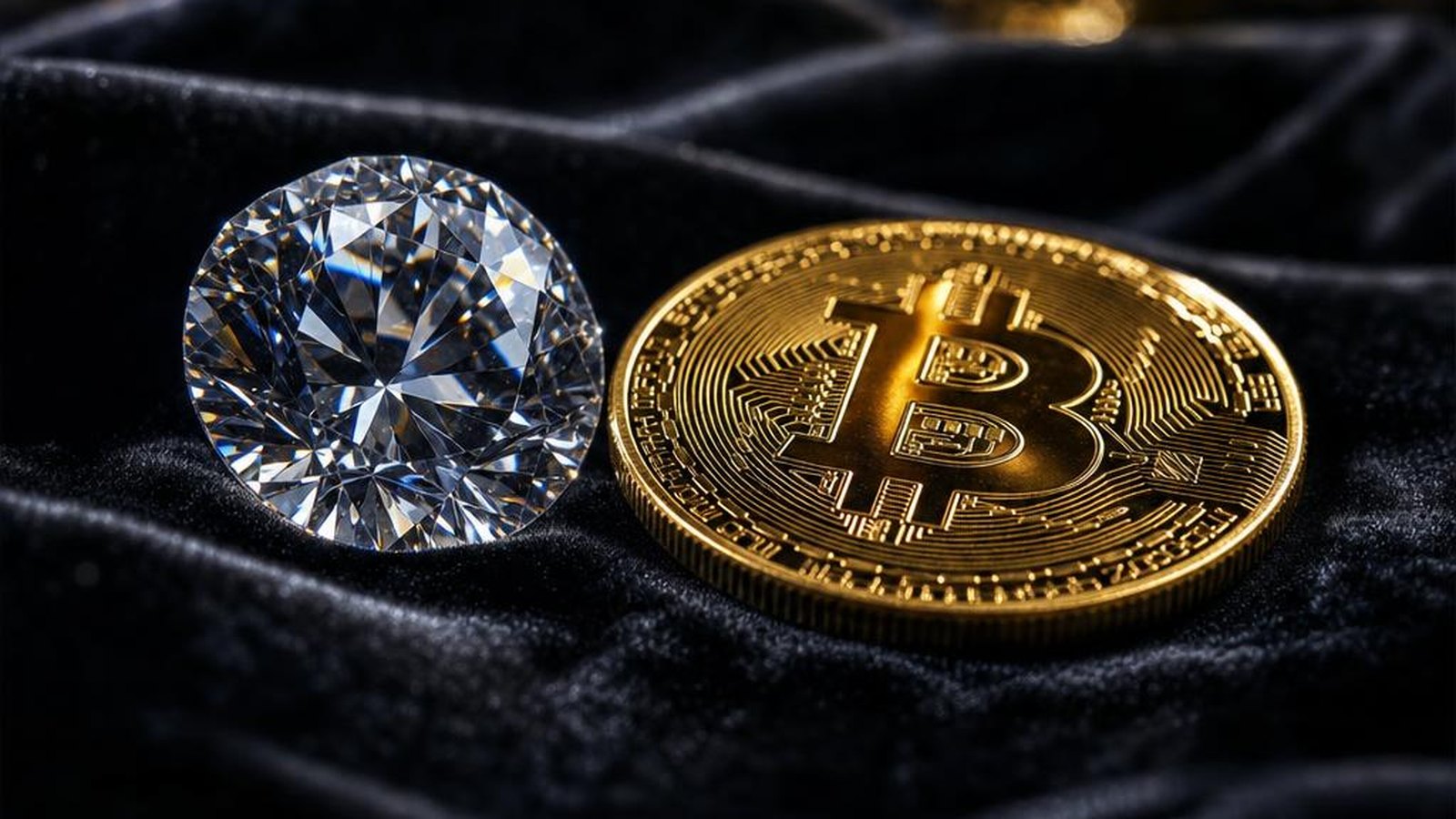
Diamonds and Bitcoin are bought for the same reason: to keep wealth safe from inflation, currency risk and the noise of everyday markets. Yet one is a stone that has been traded for centuries in closed rooms, and the other is a digital asset that trades every second of every day. Putting diamonds and crypto side by side tells you a lot about both.
Why compare diamonds and crypto at all
Wealthy investors rarely hold only one kind of hard asset. Gold, art, watches and diamonds sit next to equities and bonds, and more and more often next to Bitcoin. The question is no longer whether crypto belongs in a serious portfolio, but how it behaves next to the assets that families have used to store value for generations.
Diamonds are the most interesting comparison, because they are almost the opposite of Bitcoin. Every stone is unique, the price depends on an expert grading, and there is no single public order book. Bitcoin is perfectly identical in every unit, the price is public in real time, and anyone can verify the supply.
Key point: diamonds and Bitcoin both promise scarcity, but they deliver it in completely different ways. Diamonds rely on geology and the industry, Bitcoin relies on code.
Liquidity and price transparency
A diamond is priced by the 4Cs: carat, colour, clarity and cut. Two stones of the same weight can differ in value many times over. Dealers work with private price lists and the spread between the buying and selling price is wide. Selling a stone quickly usually means accepting a noticeably lower price than the one paid in a shop.
Bitcoin is the opposite. One coin equals any other coin, the market is open 24 hours a day, and the price is visible on every exchange. The cost of that transparency is volatility: Bitcoin can move more in a week than a diamond price list moves in a year.
Diamonds have no daily public price, which is why serious analysis looks at official trade statistics: how much India, the world's main cutting centre, exports and how much the United States, the largest consumer market, imports. These flows show the real pulse of the industry.
Supply: mines, labs and a fixed cap
For decades the diamond story was simple: a few large miners controlled supply, and natural stones were scarce. The Kimberley Process, in place since 2003, tracks rough diamond production and trade between participating countries.
Then laboratories learned to grow diamonds that are chemically and physically the same as mined ones. Lab-grown stones became cheaper every year and took a growing share of the jewellery market, which put real pressure on the prices of natural diamonds. Scarcity in the diamond world now depends on whether buyers keep paying a premium for natural origin.
Bitcoin's scarcity is written in the protocol: there will never be more than 21 million coins, and the issuance schedule is public. No lab and no company can change that.
Scarcity alone does not guarantee value. Both markets depend on demand: diamonds on jewellery buyers and collectors, Bitcoin on investors and adoption. Past behaviour of either asset does not promise future results.
Diamonds vs Bitcoin at a glance
| Feature | Diamonds | Bitcoin |
|---|---|---|
| Unit | Every stone is unique | Every unit is identical |
| Price discovery | Private price lists and expert grading | Public, real time, on many exchanges |
| Trading hours | Dealer hours, slow sale | 24 hours, 7 days a week |
| Supply | Mines plus fast growing lab production | Fixed cap of 21 million |
| Volatility | Low on paper, hidden in wide spreads | High and fully visible |
| Storage | Physical, vault or safe | Digital, wallet or custodian |
How the two can work in one portfolio
An asset is useful in a portfolio not only because of its own return, but because of how it moves against everything else. If diamonds barely react when Bitcoin falls, a small allocation to them can change how a portfolio behaves during a crypto crash. If they start moving together, that protection disappears.
That is why it makes sense to watch correlations rather than opinions: diamonds against Bitcoin and Ethereum, against gold, and against tokenised gold such as PAXG, which brings a classic store of value onto the blockchain.
The most useful question is not "diamonds or Bitcoin", but "how do they behave together when markets get rough".
FAQ
Are diamonds a good hedge against a Bitcoin crash?
It depends on the period. Diamond prices react slowly and are driven by jewellery demand, so they often move differently from crypto. The only honest answer comes from data: check how diamonds behaved during past Bitcoin drawdowns instead of relying on a rule of thumb.
Why do lab-grown diamonds matter for investors?
Lab-grown stones are physically the same as mined ones but much cheaper to produce. Their growing share puts pressure on natural diamond prices, so the split between natural and lab-grown trade is one of the most important signals in the market.
Is there a "Bitcoin of diamonds"?
Not really. Diamonds cannot be standardised the way a digital asset can. The closest bridge between hard assets and crypto today is tokenised gold, such as PAXG, which is why it is worth watching next to both markets.
Where can I see diamond market data next to crypto?
On CryptoPulsar AI. The Diamonds module shows the diamond trade index, natural and lab-grown trade and correlations with Bitcoin, Ethereum, gold and PAXG on one screen.
Diamonds and crypto on one screen, only at CryptoPulsar AI
CryptoPulsar AI is the crypto analytics platform that also tracks the diamond market. In the Diamonds module, part of the Pulse Alpha plan, you will find a diamond trade index built on official trade data, natural versus lab-grown diamonds, a world map of diamond trade, correlations with Bitcoin, Ethereum, gold and PAXG, a look at how diamonds behaved during Bitcoin crashes and an AI commentary on the diamond market.
This article is for education only and does not constitute investment advice. Always do your own research.